Service Dogs in Maine: Training, Access Rights and Where to Start
This page explains the law in general terms. It is not legal advice. For a specific situation, contact the agency listed on this site or an attorney.
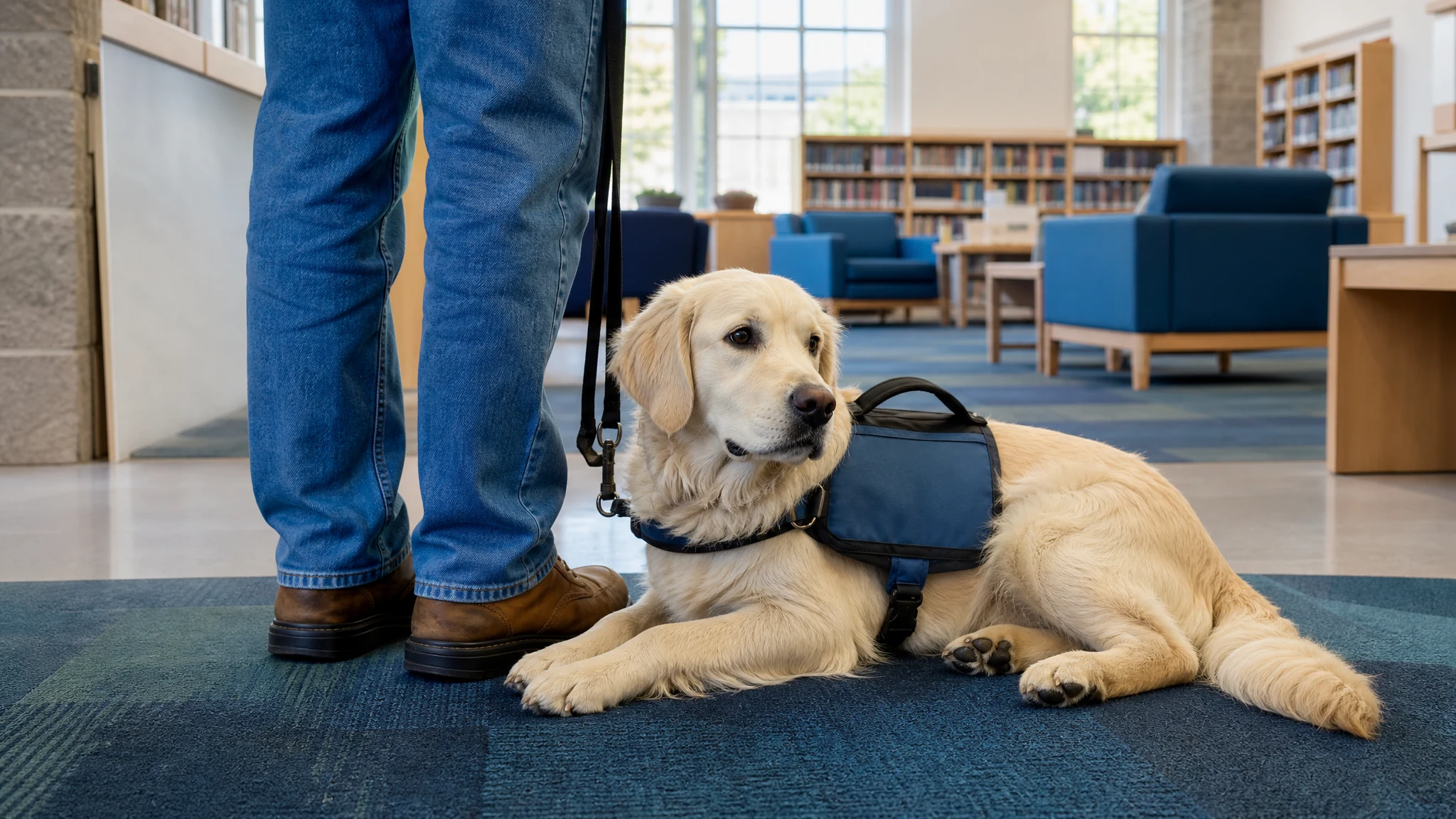
A service dog can change daily life for a person with a disability. Getting one, and understanding where it can go, involves two layers of law and a few real choices about how to train. This guide covers what a service dog is under federal and Maine law, who may use one, the two main routes to getting one, what training involves, what it costs, and where to begin.
It is written for Maine residents, but the federal rules apply everywhere in the country. It explains the law in plain English. It is not legal advice.
Key Takeaways
- Under the ADA, a service animal is a dog individually trained to do work or perform tasks for a person with a disability. The tasks must be directly related to the disability (ADA.gov).
- Maine's definition in Title 5 section 4553 is also a dog individually trained to do work or perform tasks for a person with a disability. It covers dogs only.
- Emotional support, therapy and comfort animals are not service animals under the ADA.
- No official registry or certification is required under the ADA. Online registrations and ID cards are not legal proof of anything.
- Maine law bars a fee or security deposit for a service animal. The handler is still liable for damage the animal causes.
- There are two routes: a dog from a training program, or a dog you train yourself, with or without professional help.
- Knowingly passing off a pet as a service animal can bring a civil fine of up to $1,000 per occurrence under 17 M.R.S. section 1314-A.
Table of Contents
- What counts as a service dog in Maine
- Access rights under the ADA and Maine law
- Who can use a service dog
- The two routes: program-trained or owner-trained
- What service dog training involves
- Organizations to know in and around Maine
- Costs and where to start
- Handler responsibilities and common mistakes
What Counts as a Service Dog in Maine
The word "service dog" gets used loosely. The law does not use it loosely. Two definitions matter in Maine, and they line up.
The federal definition
ADA.gov, in its Frequently Asked Questions about Service Animals and the ADA, says a service animal is a dog individually trained to do work or perform tasks for an individual with a disability. The tasks must be directly related to the person's disability.
Two parts of that sentence do most of the work. The dog is individually trained, and it does work or tasks. A dog that is simply calming to be around does not meet the definition.
The Maine definition
Maine's Human Rights Act, in Title 5 section 4553, subsection 9-E, defines a service animal as a dog individually trained to do work or perform tasks for the benefit of an individual with a disability. The older definition in subsection 9-D has been repealed. The text read for this guide covers dogs only and does not include a provision for miniature horses.
Title 17 section 1312 of the Maine Revised Statutes uses the term "service dog" and points back to the same Title 5 definition. So whether you read the civil rights law or the service dog statute, the test is the same.
What is not a service dog
Emotional support animals, therapy animals and comfort animals are not service animals under the ADA. Maine's public accommodation provision, Title 5 section 4592(8), says the same thing in its own way. It does not apply to an "assistance animal" unless that animal also qualifies as a service animal.
This does not mean support animals have no protections anywhere. Maine's housing law has its own rules for assistance animals, covered below. But in a restaurant, store or hotel lobby, the service animal definition is what counts.
Examples of tasks that can qualify include guiding a person who is blind, alerting to a sound, retrieving items, providing balance support, or interrupting a harmful behavior linked to a psychiatric disability. Whether a specific task counts depends on whether it is trained and tied to the disability. ADA.gov explains the details.
Access Rights Under the ADA and Maine Law
The ADA and Maine law both protect a person with a disability who uses a service dog. Maine's law adds specific language on fees and deposits.
What staff may ask
ADA.gov says that when it is not obvious that a dog is a service animal, staff may ask only two questions:
- Is the dog a service animal required because of a disability?
- What work or task has the dog been trained to perform?
Those are the two questions the ADA allows. The federal FAQ on ADA.gov is the place to check what else a business may or may not ask or require.
Public places under Maine law
Title 5 section 4592, subsection 8, makes it unlawful for a public accommodation to refuse the use of a service animal or otherwise discriminate against a person with a physical or mental disability who uses one. A public accommodation is a business or facility open to the public, such as a shop, restaurant or lodging.
The statute allows a defense in three situations. The business must show that the animal:
- poses a direct threat to health or safety,
- would cause substantial physical damage to property, or
- would substantially interfere with others' reasonable enjoyment.
The key phrase is "it is shown by defense." A business cannot turn a team away just because it would rather not have a dog. The burden is on the business.
No fee or deposit
Under the same subsection, use of a service animal may not be conditioned on a fee or security deposit. The handler is still liable for damage the animal does. That is a fair balance: no surcharge for access, but responsibility for actual harm.
Housing
Maine's housing provision, Title 5 section 4582-A, subsection 3, says a housing provider may not refuse the use of an assistance animal or discriminate against a person with a physical or mental disability who uses one. The same three defenses apply: direct threat, substantial physical damage, or substantial interference with others' reasonable enjoyment. No fee or security deposit may be required, and the person is liable for damage the animal does.
Title 17 section 1312, subsection 5, also gives a person with a service animal full and equal access to housing and bars extra compensation.
Housing is where Maine's two terms matter most. "Assistance animal" in the housing statute is a broader idea than "service animal" in the public access statute. If you have a housing question, read both sections, and consider contacting the agency that enforces the law (see the next section on complaints). For federal housing rules, HUD is the agency to check.
Air travel and employment
Air travel with a service dog is governed by the U.S. Department of Transportation, which publishes its own rules. Check DOT directly before you fly. The Maine employment rules for service animals were not confirmed for this guide, so check with the relevant agency or an employment attorney if this applies to you.
Dogs in training
Title 17 section 1312, subsection 4, gives a specially trained service dog trainer, while engaged in the actual training process and activities of service dogs, the same rights, privileges and responsibilities as people with disabilities for access to and use of public facilities. The text names trainers. It does not state any age, harness or ID conditions. Title 5 section 4592(8) itself does not mention dogs in training.
If you are an owner-trainer, do not assume that provision covers you. Read the statute and confirm how it applies before you take a dog still in training into a business. The ADA definition describes a dog that is individually trained, so check ADA.gov for how it treats dogs that are not yet finished.
Pretending a pet is a service dog
Title 17 section 1314-A of the Maine Revised Statutes, titled "Misrepresentation as service animal or assistance animal," makes it a civil violation to knowingly misrepresent an animal as a service or assistance animal when it does not meet the Title 5 section 4553 definitions. The examples listed include:
- creating or giving out false documents,
- putting a harness, collar, vest or sign typically used by people with disabilities on a non-service animal, and
- claiming an animal is a service animal when it has not completed disability-related training.
The fine is up to $1,000 per occurrence. This is one more reason to stay away from online "registration" kits.
If your rights are denied
ADA.gov explains how to file a federal complaint. For a complaint under the Maine Human Rights Act, check with the state agency that handles those complaints for its current process and deadlines. This guide does not give legal advice, and an attorney or disability rights organization can help with a specific situation.
Who Can Use a Service Dog
The ADA does not list approved conditions. What matters is that the person has a disability and that the dog is individually trained to do work or perform tasks directly related to that disability. Maine's statute speaks of a person with a "physical or mental disability," so psychiatric conditions are not excluded.
People who use service dogs include people who are blind or have low vision, people who are deaf or hard of hearing, people with mobility limitations, people with seizure disorders or diabetes, and people with psychiatric disabilities such as PTSD. The category depends on the tasks, not the diagnosis name.
Do you need paperwork?
Under the ADA there is no official service dog registry and no required certification. Nobody has to register or certify a dog. Websites that sell registration, ID cards or certificates are not part of any legal system, and holding one is not legal proof that a dog is a service animal. Do not buy one expecting it to open doors.
Some programs do issue their own graduation papers or ID. That is a record from that program. It is not a government credential. Programs may also help with documentation for other purposes, such as housing or travel. Ask the program what it provides.
Is a service dog right for you?
A service dog is a commitment of years. Think honestly about these questions before you start:
- What specific tasks would the dog do that you cannot do easily yourself?
- Can you manage daily care, exercise, grooming, veterinary visits and ongoing training?
- Is your home stable enough for a dog for a decade or so?
- Can you handle the attention that comes with a visible working dog in public?
Your doctor or therapist can talk through whether a service dog fits your situation. For some people, other tools or support are a better match.
The Two Routes: Program-Trained or Owner-Trained
People looking at how to get a service dog in Maine generally choose between two paths. Both are legal under the ADA. The right one depends on your disability, your time, your money and how much dog-training work you can take on.
Route one: a program-trained dog
Nonprofit programs breed, select or place dogs, train them, and teach the handler to work with the dog. Some serve specific groups, such as veterans. Some have waitlists, and some require the applicant to meet specific eligibility rules. Costs vary a lot from program to program, so ask each one directly. A later section lists organizations that serve Maine or are close by.
Advantages: trained staff handle most of the selection and training, and you are matched with a dog suited to the work.
Trade-offs: waits can be long, eligibility may be narrow, and a program may not train for your specific need. One Maine program, for example, states plainly that it does not train guide dogs or alert dogs of any kind.
Route two: an owner-trained dog
The ADA does not require a service dog to come from a program or professional trainer. A person with a disability may train their own dog. Many do, often with help from a private trainer for the foundation skills and for the tasks.
Advantages: you choose the dog, you control the timeline, and you build the bond from day one.
Trade-offs: the work is large and the risk is real. Not every dog has the temperament, health or drive for service work, and a dog may wash out after months of effort. You also carry all the training burden while managing your own disability.
A hybrid approach
Some people start with a dog from a rescue, a breeder or a program, then hire a qualified private trainer to coach them through the task training and public access skills. Whichever route you take, look for a trainer who uses humane, reward-based methods.
What Service Dog Training Involves
Service dog training in Maine, like anywhere, has three layers: foundation behavior, public access skills, and the trained tasks that relate to the handler's disability.
Humane methods only
Use reward-based training, in line with the position of the American Veterinary Society of Animal Behavior (AVSAB). That means rewarding behavior you want with food, play or praise. It does not include shock, prong or choke collars, alpha rolls, scruffing or any dominance-based method. Those methods raise fear and stress, which are the opposite of what a working dog needs. A service dog has to stay relaxed and confident in busy places for years.
Layer one: foundation skills
- Name response and attention. The dog learns to check in with you around distractions.
- Sit, down, stay, come and settle. The settle, where the dog lies quietly for a long time, matters most.
- Loose-leash walking. Pulling is a safety issue and a sign of poor focus.
- Handling and grooming. The dog accepts touch, brushing, nail trims and vet exams.
- House manners and potty reliability. A dog that has accidents in public will not be welcome.
Layer two: public access skills
Public access training teaches the dog to behave in places where people and other animals are everywhere. Good public behavior includes:
- ignoring food on the floor, dropped items and strangers who try to pet or call to the dog,
- staying calm around other dogs,
- riding quietly in vehicles and on public transit,
- settling under a table or beside a chair for long periods,
- handling sounds, slick floors, elevators, automatic doors and crowds, and
- staying out of the way of carts, wheelchairs and people walking by.
Maine gives you a mix of settings to practice: small-town main streets, busy tourist areas in summer, quiet rural roads, and harsh winters with snow, ice and salt. A dog that handles icy sidewalks, boots and wet floors in February is more ready for real work.
Build up slowly. Start in quiet spaces where the dog is allowed, and increase difficulty only when the dog is relaxed. Keep sessions short. Pushing too fast is a common reason dogs fail.
Layer three: disability-related tasks
The tasks are what make the dog a service dog under the law. They must be trained, and they must relate to the handler's disability. The work depends entirely on the person. Examples include opening doors, fetching dropped items, bracing for balance, nudging or pawing to interrupt a harmful behavior, or alerting to a sound.
Break each task into small steps and reward each step. Teach the task in a quiet room first, then add distance, duration and distractions. Keep notes on what the dog can do reliably and under what conditions. A training log helps you answer the ADA's second question clearly: what work or task has the dog been trained to perform?
Choosing a dog for the work
Temperament is more important than breed. Look for a dog that is steady, friendly but not pushy, recovers quickly from surprises, and likes working with people. Health matters too, because a service dog needs sound joints, good eyesight and a body that can handle long days. Breed-specific health risks vary, so talk with a veterinarian about your dog.
Many dogs will not make it. A candidate that is fearful, reactive or easily overwhelmed is not failing. It is simply better suited to life as a pet. Retiring a dog from training is a legitimate and kind decision.
Finding a trainer
Ask any trainer you consider how they train and what tools they use. Walk away from anyone who recommends shock, prong or choke collars, or dominance methods. Ask whether they have experience with service dog work specifically, and ask to see how they work with dogs in action. This guide does not name or recommend private trainers. Check any trainer's background directly.
Organizations to Know in and Around Maine
The programs below are drawn from their own published pages. Contact each one directly for current eligibility, wait times and how to apply. Listing a program here is not a recommendation or an endorsement.
Maine Paws for Veterans
Based in the Brunswick area (office in Brunswick, mailing address in Topsham), this nonprofit matches qualified dogs with Maine veterans living with military-related PTS. The veteran and dog train together as a service dog team. The organization says it is able to offer its services to Maine veterans free of charge. Wait times are not stated on its site, so ask. Website: mainepawsforveterans.org.
K9s on the Front Line
This nonprofit runs a Service Dog Program for honorably discharged veterans diagnosed with a mental health condition from military service. Its FAQ also lists first responders. The program page says the program is free and funded by donations, and that participants pay for veterinary care, food and routine expenses. A Maine resource list places it in southern Maine, but its own page does not name a location, so confirm with the program where it operates and how its training schedule works. Website: K9s on the Front Line service dog program.
Mission Working Dogs
Based in Oxford, this nonprofit lists mobility and psychiatric (PTSD) service dogs and serves veterans among others. Its program page says candidates must fundraise $6,000 before team training. It also says, "We do not currently train guide dogs or alert dogs of any kind." If you need one of those, this is not the program. Website: Mission Working Dogs service dog program.
Canine Companions, Northern New England Chapter
Canine Companions serves children, adults and veterans with various disabilities. A Maine resource list places the Northern New England chapter in southern New Hampshire, and the chapter page gives no address, so check with the organization about how Maine applicants work with it. Its page says dogs are offered free of charge. Website: Canine Companions, Northern New England Chapter.
VA Maine Healthcare System
The VA Maine Healthcare System, which includes the Togus VA Medical Center at 1 VA Center in Augusta, offers health care for Maine veterans, including mental health care. The page reviewed does not mention a service dog program. A federal pilot under the PAWS Act, for service dog training for veterans with PTSD at several VA medical centers, has been described by the American Legion, but Maine participation was not confirmed. Ask the VA directly. Website: VA Maine Healthcare System.
Costs and Where to Start
What the programs say about cost
Based on what each organization publishes:
| Program | Cost as published |
|---|---|
| Maine Paws for Veterans | Free of charge to Maine veterans |
| K9s on the Front Line | Program is free and donor funded; participants pay for veterinary care, food and routine expenses |
| Mission Working Dogs | Candidates must fundraise $6,000 before team training |
| Canine Companions, Northern New England Chapter | Dogs offered free of charge |
Even when the dog is free, you will still have ongoing costs for food, veterinary care, grooming, supplies and travel. Wait times are not published by these programs in the pages reviewed, so ask each one.
Owner-training costs
This guide does not quote prices for private trainers, classes or veterinary care in Maine, because those vary and no verified figure is available. Ask trainers for written fee details, and ask your veterinarian about expected health costs. Plan for a long run: dog food, preventive care, emergency care and equipment over the dog's working life.
A practical starting path
- Write down your needs. List the specific tasks that would help with your disability. This will guide whether a program fits and what to train.
- Talk with your health care provider. They can help you decide whether a service dog is a good fit.
- Read the legal basics. Start with the ADA.gov service animal FAQ, then the Maine statutes cited in this guide.
- Check program eligibility. If you are a veteran, look at the veteran-focused programs first. Ask each program about eligibility, cost, wait time and the training process.
- If you want to owner-train, find a humane trainer. Look for reward-based methods and experience with service dog work.
- Plan for the long term. Think through care, costs, housing, and what happens if the dog cannot do the work.
Handler Responsibilities and Common Mistakes
Your responsibilities
- Keep the dog under control. A service dog that is out of control, or not housebroken, can be asked to leave. Check ADA.gov for the details on when a business may do so.
- Pay for damage. Maine's statutes keep the handler liable for damage the animal does, even though no fee or deposit may be charged.
- Keep up with health care. A healthy dog is a working dog. Keep vaccines, parasite prevention and checkups current.
- Stay honest. Do not claim a dog is a service animal if it has not been trained to do work or tasks. Maine's misrepresentation statute carries a fine of up to $1,000 per occurrence.
Common mistakes to avoid
- Buying a registration or ID. There is no official registry under the ADA, and these products are not legal proof.
- Confusing support with service. An emotional support animal is not a service animal under the ADA. Its protections, if any, come from other rules, such as housing law.
- Rushing public access. A dog that is not ready can fail in public, which sets back training and puts the dog under stress.
- Using harsh tools. Shock, prong and choke collars and dominance methods are not part of reward-based training. They make fear and stress worse.
- Skipping a backup plan. Dogs get sick, age and retire. Think about what you will do then.
A note for businesses
If you run a Maine business, the two questions from ADA.gov are the limit on what staff may ask. Do not ask for proof, a certificate, a demonstration or details about the person's disability. Do not charge extra fees or deposits for a service animal. If a dog is out of control or not housebroken, check the ADA.gov guidance before you act.
Putting It Together
For service dog training in Maine, the legal picture is steady. A service dog is a dog individually trained to do work or tasks for a person with a disability, under both the ADA and Maine's Human Rights Act. No registry or certificate is required. Maine adds clear language: no fee or deposit for a service animal, and a civil fine of up to $1,000 per occurrence for misrepresentation.
The practical picture takes more thought. You can apply to a program, or train your own dog with humane, reward-based methods and good support. Neither path is quick, and neither is a guarantee. Start with your needs, read the primary sources below, and contact the programs and agencies directly for the current details.
Sources
- ADA.gov, Frequently Asked Questions about Service Animals and the ADA
- Maine Legislature, Revised Statutes, Title 5 section 4592
- Maine Legislature, Revised Statutes, Title 5 section 4553
- Maine Legislature, Revised Statutes, Title 5 section 4582-A
- Maine Legislature, Revised Statutes, Title 17 section 1312
- Maine Legislature, Revised Statutes, Title 17 section 1314-A
- Maine Paws for Veterans
- K9s on the Front Line, Service Dog Program
- Mission Working Dogs, Service Dog Program
- Canine Companions, Northern New England Chapter
- VA Maine Healthcare System