Service Dog Tasks and the Public Access Test, Explained
This page explains the law in general terms. It is not legal advice. For a specific situation, contact the agency listed on this site or an attorney.
Two ideas get mixed up more than any others in service dog training: what counts as a task, and what a public access test is for. This guide covers both for handlers in Maine, then walks through how to build tasks and use a public access test as a practice benchmark.
Short version: the law cares about trained work tied to a disability. A public access test is a useful measuring stick for your training, but no law makes you pass it.
What counts as a task
ADA.gov, in its service animal FAQ, says a service animal is a dog individually trained to do work or perform tasks for an individual with a disability. The tasks must be directly related to the person's disability.
Maine's wording is close. Title 5, section 4553, subsection 9-E(B) of the Maine Revised Statutes defines a service animal as a dog individually trained to do work or perform tasks for the benefit of an individual with a disability. Title 17, section 1312 uses the term "service dog" and points back to that same definition.
Two details matter here:
- Dogs only. The Maine text we read covers dogs. Check the statute itself if you have questions about other animals.
- Individually trained. A dog that is simply friendly, well behaved or calming does not meet the definition. The dog has to be taught specific work or tasks.
What tasks can a service dog do?
The honest answer is that the list is open. The test is not whether a task appears on a list. The test is whether the dog was trained to do it and whether it relates to the handler's disability. These are examples of the kind of work handlers and trainers commonly describe, grouped by disability type.
Mobility disabilities
- Retrieving dropped items or a phone
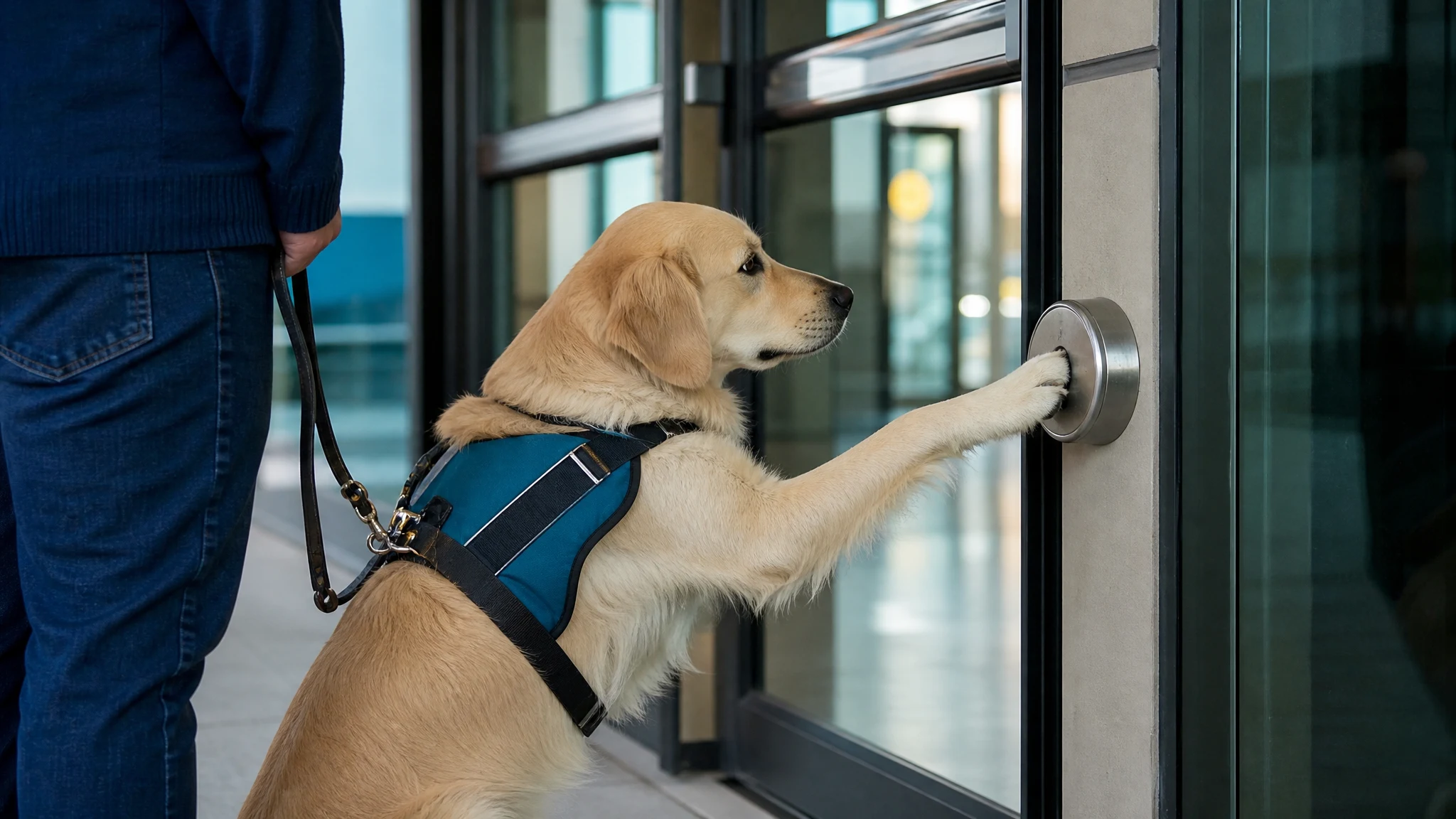
- Opening or closing doors, or pressing a door button
- Providing counterbalance or bracing support on request
- Pulling a manual wheelchair
Hearing loss
- Alerting the handler to a doorbell, alarm or a person calling their name
- Leading the handler to the source of a sound
Vision loss
- Guiding around obstacles and stopping at curbs or stairs
Psychiatric disabilities, including PTSD
- Interrupting repetitive or self-injuring behavior
- Turning on lights or checking a room on cue
- Creating space in a crowd by positioning between the handler and other people
- Waking the handler from nightmares
- Reminding the handler to take medication at a set time
Medical conditions
- Alerting to a change the handler cannot easily sense, when the dog has been trained to do so
- Fetching medication or a phone, or getting help during an episode
For a longer list, see the ADA.gov service animal FAQ linked in the sources below.
Why comfort alone is not a task
Emotional support, therapy and comfort animals are not service animals under the ADA. Providing comfort by being present is not work or a task in the legal sense.
Maine draws the same line. Section 4592, subsection 8 explicitly does not apply to an "assistance animal" unless that animal also qualifies as a service animal. Housing is covered separately under section 4582-A, subsection 3, which uses the "assistance animal" term.
A useful way to check: could you describe what the dog does on cue or in response to a specific trigger, in one sentence? "She presses the door button when I tap my leg" is a task. "He makes me feel better" is real, but it is not a task.
This matters at the door of a business. The ADA.gov FAQ says that when it is not obvious that a dog is a service animal, staff may ask only two questions: is the dog a service animal required because of a disability, and what work or task has the dog been trained to perform? A handler who can answer the second question clearly rarely has trouble.
What the public access test is, and what it is not
A service dog public access test is a structured set of exercises that checks whether a dog stays calm, controlled and unobtrusive in public places. Assistance Dogs International (ADI) publishes a public access standard that many assistance dog programs use as a benchmark. Check ADI directly for its current wording, since this article does not reproduce it.
Here is the part people get wrong:
- It is not an ADA requirement. The ADA does not require a public access test, a certificate or any registration. There is no official service dog registry or required certification under the ADA.
- It does not make a dog legal. A dog's status comes from the definition above: individually trained to do disability-related work or tasks.
- It is a training benchmark. Passing a test in practice shows you where your dog is reliable and where it needs more work.
An online registration, ID card or certificate is not legal proof of anything. This site does not recommend them.
Maine rules that affect your training
Under Title 5, section 4592, subsection 8, a place of public accommodation may not refuse the use of a service animal or otherwise discriminate against a person with a physical or mental disability who uses one. The statute lets a business raise a defense if the animal poses a direct threat to health or safety, would cause substantial physical damage to property, or would substantially interfere with others' reasonable enjoyment. The handler may not be charged a fee or security deposit for the animal, though the handler is liable for damage the dog does.
Those defenses are why behavior training matters. A dog that is out of control or disruptive gives a business a reason to act.
Two more Maine points:
- Dogs in training. Title 17, section 1312(4) gives a specially trained service dog trainer, while engaged in the actual training process and activities of service dogs, the same rights, privileges and responsibilities as people with disabilities for access to public facilities. The text names trainers, not every handler, so check the statute before assuming it covers your situation.
- Misrepresentation. Title 17, section 1314-A makes it a civil violation to knowingly misrepresent an animal as a service or assistance animal when it does not meet the Title 5 definitions. Examples include giving out false documents, putting gear typically used by people with disabilities on a non-service animal, or claiming an animal is a service animal when it has not completed disability-related training. The fine is up to $1,000 per occurrence.
For the broader picture, see our guide to service dogs in Maine: training, access rights and where to go.
How to train tasks and practice for a public access test
Materials needed
- A well-fitted flat collar or harness and a standard six-foot leash
- Small, soft, high-value treats, plus a treat pouch
- A mat or small bed the dog already likes
- A notebook or phone to log each session
- A helper who can act as a stranger or distraction
- Access to places you are allowed to practice, with permission where needed
Step 1: Write down the tasks
List each task, the cue or trigger, and how it relates to your disability. This keeps you honest about the legal definition and gives you a clear answer to the second ADA question.
Step 2: Teach each task with rewards
Use reward-based methods, in line with the American Veterinary Society of Animal Behavior (AVSAB). Break the task into small pieces. Mark the right behavior, then reward it. For a retrieve, for example, reward looking at the item, then touching it, then mouthing it, then picking it up, then bringing it to you.
Do not use shock, prong or choke collars, or force and dominance methods. They add stress and tend to damage the trust that task work depends on.
Step 3: Build the task into real life
Once the dog does the task at home on cue, practice in new rooms, with new items and at different times of day. If the task responds to a trigger, such as an alarm or a change in your state, practice with the real trigger as safely as you can.
Step 4: Build calm basics
Public access skills are mostly about relaxed, boring behavior. Many handlers practice:
- Walking on a loose leash past people, food and other dogs
- Settling on a mat under a table or chair for a long stretch
- Ignoring dropped food
- Waiting calmly at doors and in elevators
- Staying quiet and relaxed when a stranger approaches or speaks
- Coming when called, even with distractions around
- Staying clean and comfortable with brushing and handling
Step 5: Add distractions slowly
Start in a quiet place, such as a parking lot edge or a hardware store aisle at an off hour. Raise the difficulty one step at a time. If the dog struggles, go back to an easier setting. Short, successful sessions work better than long, shaky ones.
Step 6: Run a practice public access test
Look up the current ADI standard and use it as your checklist. Have your helper play the stranger, and ask a friend to watch and score you honestly. Score the handler too. Handler errors, like a tight leash or repeating a cue, are worth catching early.
Step 7: Log, review and repeat
Write down what went well and what slipped. Retest the weak spots in a few weeks. A dog that works well at one location may need practice again in a new one.
Tips
- Train when the dog is rested and fed normally, not wound up or overtired.
- Keep sessions short, and end on a success.
- Reward calm behavior often, especially in the first minutes after arriving somewhere new.
- Watch for stress signs, such as lip licking, yawning, panting or turning away. Take a break if you see them.
- Ask a program or trainer about their own testing. Programs set their own standards, so check with them directly.
Common mistakes to avoid
- Treating comfort as a task. If the dog has not been trained to do specific disability-related work, it does not meet the definition.
- Believing a certificate or registration protects you. The ADA has no registry, and Maine can fine knowingly false claims.
- Skipping the boring work. Task skills mean little if the dog cannot settle in public.
- Jumping to crowds too fast. Rushing can cause setbacks that take weeks to repair.
- Using correction tools. Harsh tools can cause fear and reactivity.
- Treating the test as a one-time exam. It is a snapshot. Keep practicing after you pass.
Expected results
With steady, reward-based practice, many handlers find their dogs become calmer and more reliable in public over weeks to months. Timelines vary a great deal by dog, by the task and by the handler's practice schedule, and no outcome is guaranteed. Some dogs are not suited to public work, and that is a legitimate result of honest testing.
Where to go with questions or complaints
This article states what the laws say. It is not legal advice. The ADA.gov service animal FAQ is the federal reference. For a Maine access complaint, check with the appropriate state agency for its current process, since we could not confirm the details here.
Sources
- ADA.gov, Frequently Asked Questions about Service Animals and the ADA
- Maine Legislature, Revised Statutes, Title 5 section 4553
- Maine Legislature, Revised Statutes, Title 5 section 4592
- Maine Legislature, Revised Statutes, Title 5 section 4582-A
- Maine Legislature, Revised Statutes, Title 17 section 1312
- Maine Legislature, Revised Statutes, Title 17 section 1314-A